
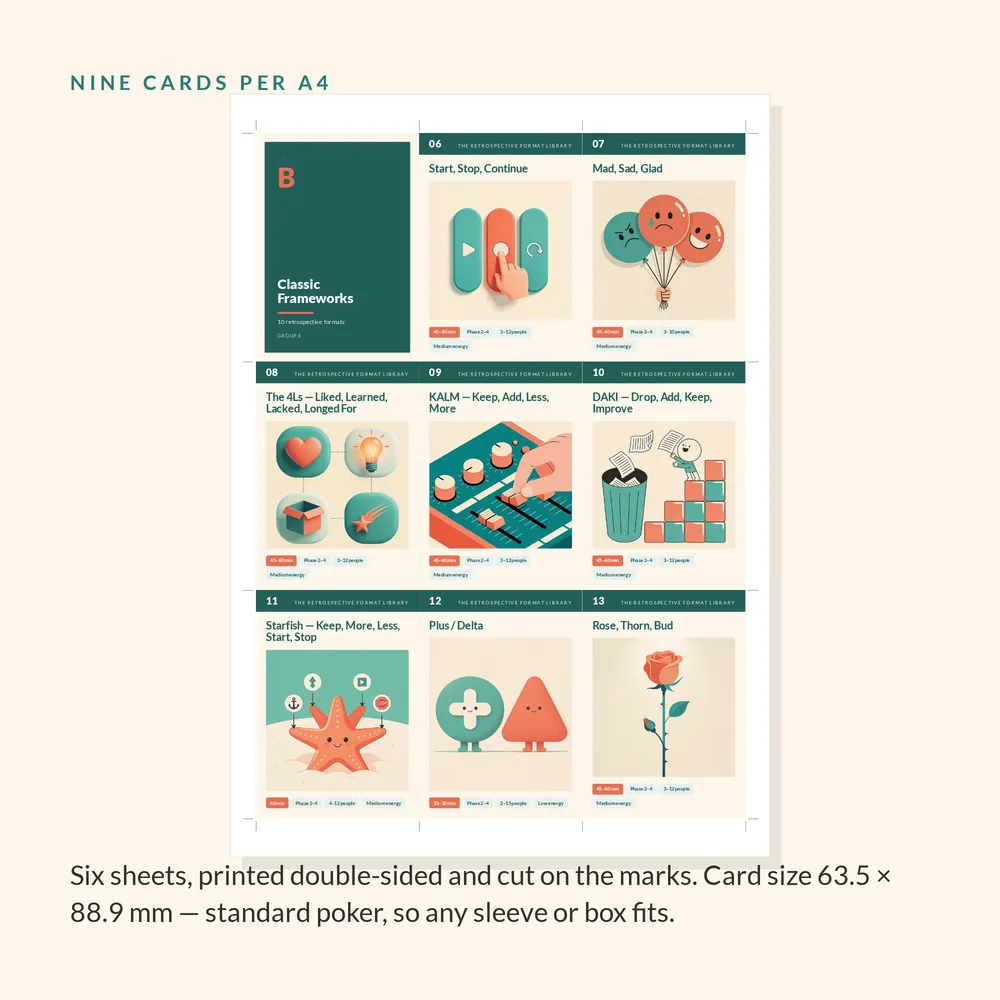
Fifty-four cards. Nine per A4.
The same 45 formats and 45 icebreakers, but as something you hold. Print them at home, cut on the marks, and the deck goes in your bag instead of your bookmarks. Two decks, €19 each.
- 54 cards per deck
- Poker size, 63.5 × 88.9 mm
- Six A4 sheets, double-sided
- Print at home
Why nine, and not four?
A6 would have been the obvious choice, and it is the wrong one: A4 is exactly four times A6, so a 3×3 layout is impossible and a 2×2 layout leaves zero millimetres of margin. No home printer can do that.
Poker size solves it. Nine cards fill 190.5 × 266.7 mm and leave 9.75 mm at the sides and 15.15 mm top and bottom — comfortable on any printer. It is also the size every card sleeve and card box in the world is made for.
Front to choose. Back to run it.
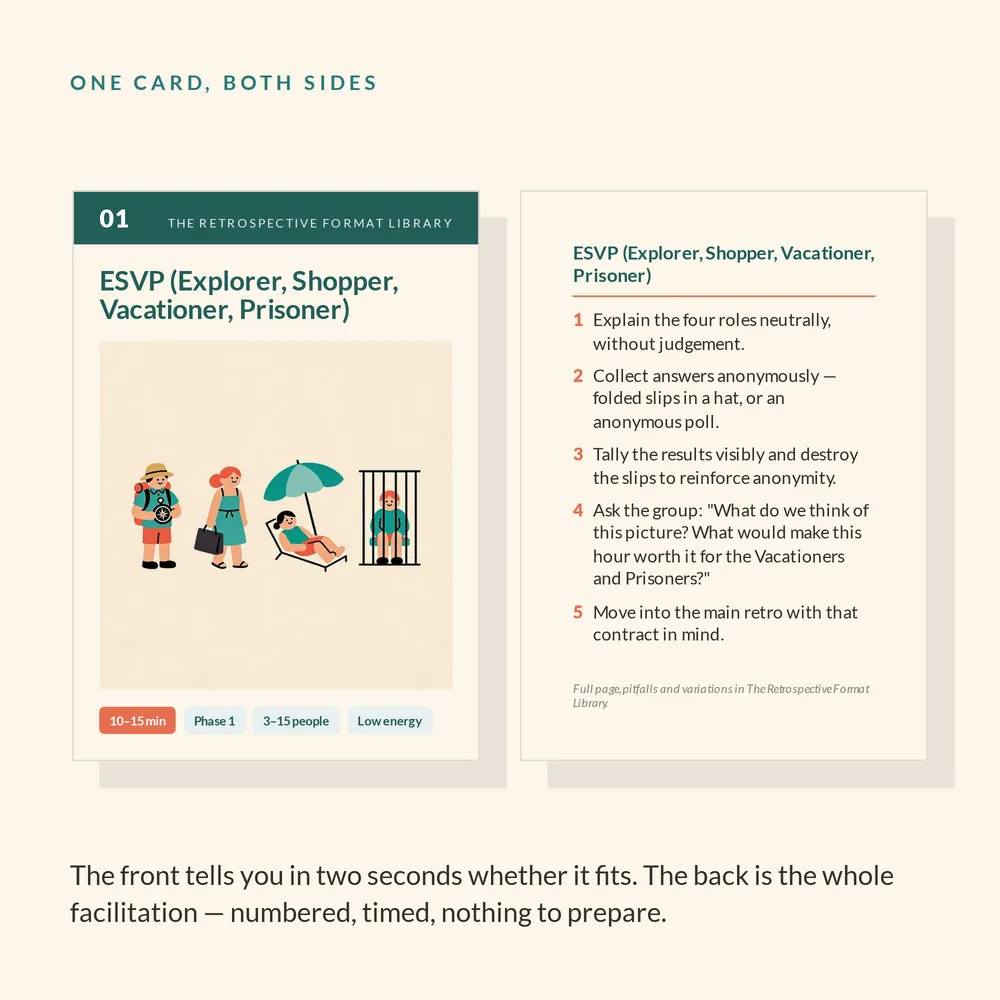
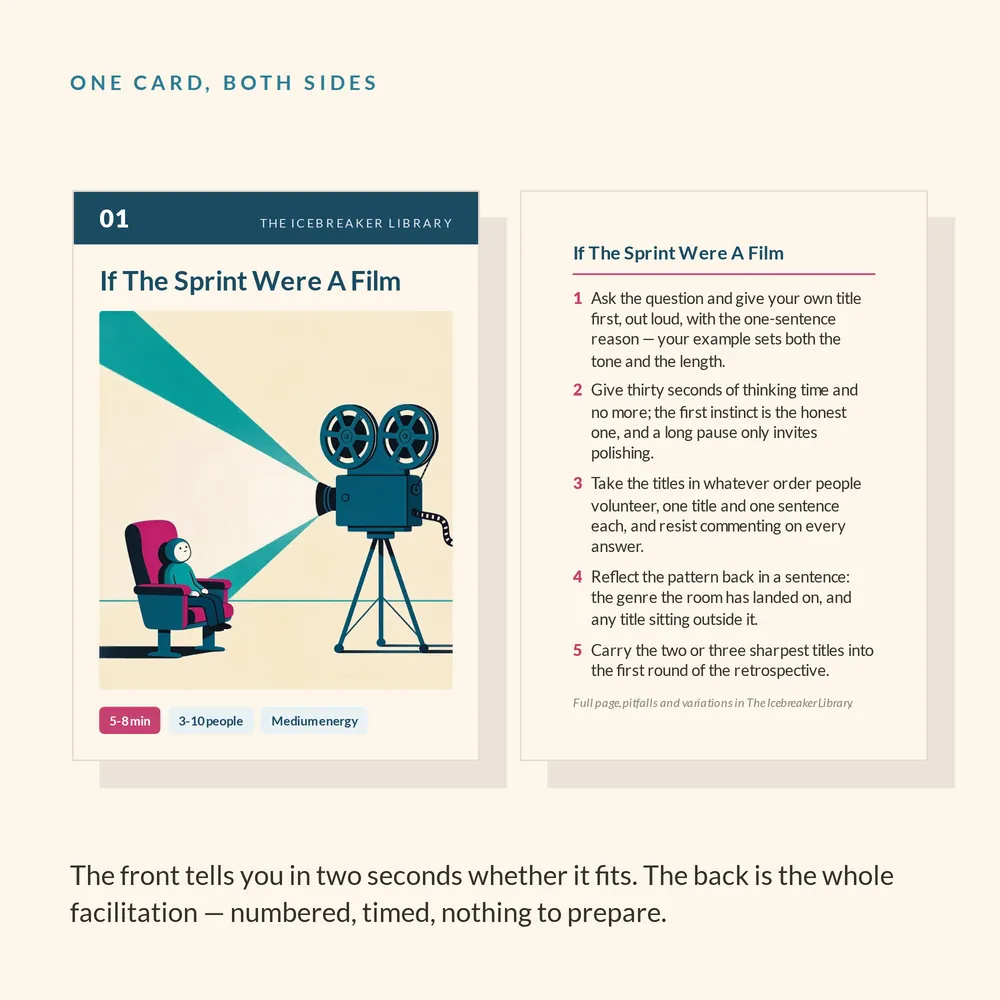
The front
Number, library, name, the illustration, and three or four chips: time, phase or setting, group size, energy. Enough to pick from a fan of cards without turning any of them over.
The back
The facilitation steps in full. That was the open question when we started — and the text fits: a median of 754 characters for the icebreakers and 399 for the retro formats. Nothing had to be shortened.
Nine helper cards
A title card that doubles as the contents, a print card with the settings, a “which one?” card with five ways in, and six tab cards — one per group, with that group’s contents on the back.
Read this before you press print.
- A4, scale 100%. Not “fit to page” — that shrinks the cards and the cutting marks stop matching the size.
- Double-sided, flip on the long edge. Flip on the short edge and every back lands on the wrong card. It says so on the print card in the deck as well.
- 200–250 g/m² gives a card that shuffles. Ordinary paper works for a first run.
- Cut on the marks. Six sheets, twelve pages, 54 cards, no half-empty last sheet.
The backs are drawn with 8 mm of inset instead of 5, and without a bleeding background. Home printers put the second side up to 2 mm out of register, and a full-bleed back would show a white strip on one side and colour over the cut line on the other. This way a small misalignment is invisible.
€19 each, on Etsy.
A deck is a product in its own right, not a bonus with the library: 54 designed cards, laid out and checked one by one.
Retrospective Card Deck
All 45 retrospective formats as printable cards, plus nine helper cards.
€19
Excl. VAT — added at checkout.
Going live on the shop this week.
Icebreaker Card Deck
All 45 icebreakers as printable cards, plus nine helper cards.
€19
Excl. VAT — added at checkout.
Going live on the shop this week.
The deck is for the room. The library is for the prep.
A card carries the steps and the chips: enough to run a format you have chosen. The library carries the purpose, the pitfalls, the variations, the board templates and the index that helps you choose. Most facilitators want the library first and the deck second — but if what you miss is something to hold in a workshop, start with the deck.
How this was made. Selected, specified and reviewed by Sven Vogelezang, a working Product Owner and Scrum Master. The text and the illustrations were produced with AI tools under his direction: he set the structure, the metadata system and the quality bar, decided what went in and what stayed out, and reviewed the result. Nothing here is bulk-generated — every page was written against a house style, and a full review before release corrected three dozen problems, from impossible timings to activities that quietly exclude people.