
45 icebreakers that survive
contact with a real team.
Lists of icebreakers are free and everywhere. What none of them tell you is how long this one really takes with eleven people, what it does to the room afterwards, and which two questions in it will make someone go quiet. That is what this library is.
Price excludes VAT; it is added at checkout. Prefer Etsy? It’s there too.
- 45 icebreakers
- 45 illustrations
- PDF + EPUB
- Six themes
- Instant download
The problem was never finding one.
Search for icebreakers and you get a hundred in ten seconds. Then you have to work out, alone and usually five minutes before the meeting, whether “two truths and a lie” takes eight minutes or twenty-five with this many people, whether it works when four of them are on Teams, and whether it will land as fun or as an intrusion for the colleague who started on Monday.
Every one of the 45 guides in this library answers those questions on the first page, in the same seven-row table, before you read a single instruction.
Seven answers, before the instructions.
Best used in
Retro, standup, planning, kickoff, workshop — the moment this one is actually for.
Group size
The range where it works, not the range where it technically functions.
Time needed
Checked against the group size. Several cards were rewritten because the two didn’t add up.
Energy level
What it asks of the room, and what it hands back to the meeting that follows.
Setting
In person, remote, hybrid — stated honestly, including the ones that only half work on a call.
Type
Question round, activity, game, reflection. What the room will be doing with its hands.
Materials
Everything you need to have ready. “None” only where it’s true.
And then the script
Numbered steps, pitfalls, variations — and on the longer ones, a lined page for your own notes.
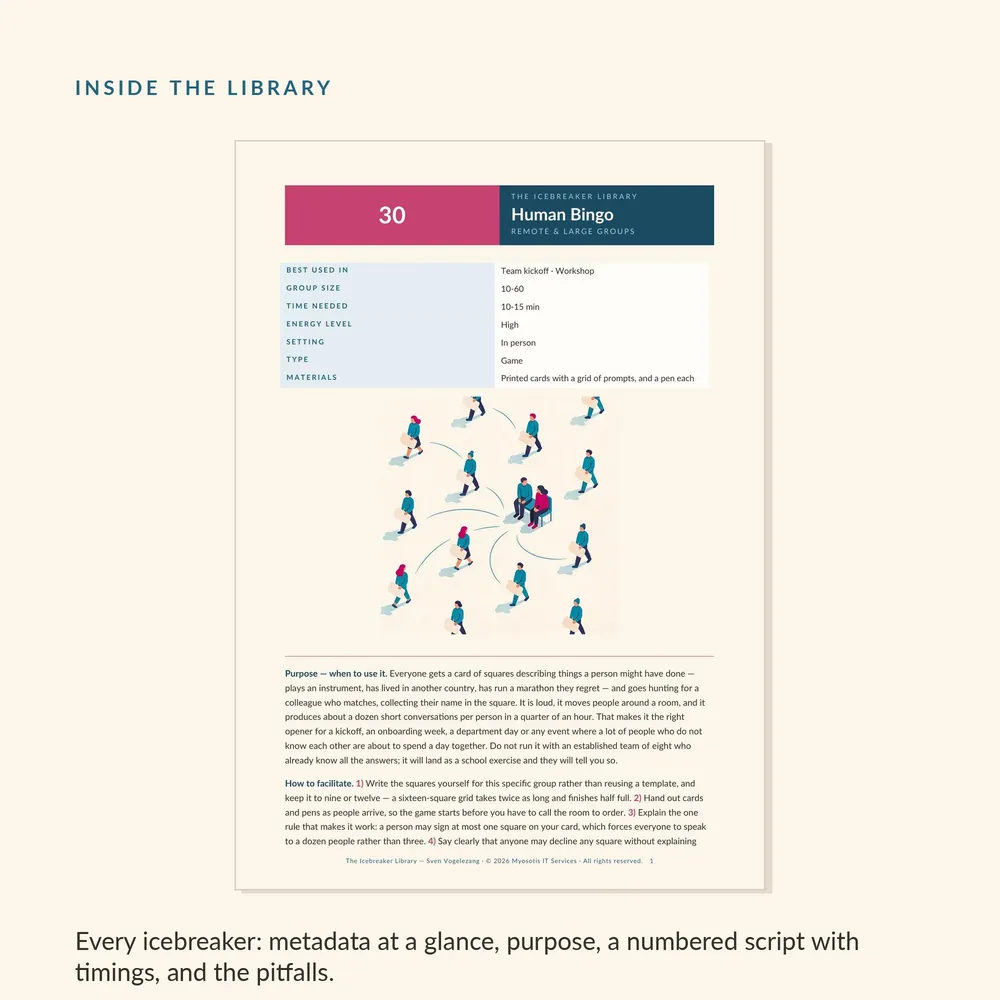
The table comes first.
Seven rows, in the same order on all 45 cards: where it is best used, the group size, the time it really takes, the energy level, the setting, the type and the materials. You can rule an icebreaker in or out without reading past the top third of the page.
Twenty-two of the 45 fit on one page. The other twenty-three run to two, with the variations and a lined block for your own notes on the second.
Chosen for the situations you actually face.
45 selected from a database of 141 across 22 categories, grouped the way a facilitator’s week is grouped.
Ceremonies
Openers for the retro, the standup and planning. Short, repeatable, and built not to eat the meeting they’re opening.
New teams & onboarding
The first weeks, when nobody knows who to ask what. Designed so the newest person isn’t the one on the spot.
Energy & games
For the graveyard slot after lunch and the third hour of a workshop. Movement, laughter, and a clear way to stop.
Remote, hybrid & large groups
Built for a call rather than adapted to one — and for the twenty-person session where a talking round would take forty minutes.
Trust, values & wellbeing
The ones that go somewhere. Each states what it asks people to reveal, so you can decide whether this team is there yet.
Depth, learning & creativity
For when the icebreaker is doing real work: opening a difficult topic, or getting a team to think differently before it decides.
The selection is the product.
141 candidates went in, 45 came out. Three deliberate decisions explain most of the difference.
Eight cut for overlap
ESVP, Weather Report, One Word, Timeline, the energy line, the speedboat check-in, the appreciation round and the traffic-light health check all exist as full formats in the Retrospective Format Library. They were removed here so that buying both never buys the same thing twice.
Twenty-nine held back
The seasonal icebreakers — the ones that only work in December, or only in the week before the summer break — were kept out. A library you can only use twice a year isn’t a library.
Thirty-six problems fixed
A full review before release found 36 issues, 14 of them blocking: timings that couldn’t work at the stated group size, four cards claiming “materials: none” that needed pen and paper, one activity asking a question that another card names as a pitfall, and wrong advice about image rights. All corrected before anything was published.
Some need a page. Some need two.
Twenty-two of the 45 are one-page cards — a short opener doesn’t need an essay, it needs to fit on the thing you hold while you run it. The other twenty-three are two-page guides at the same depth as the retro library: purpose, step-by-step script, pitfalls, variations, and a lined block of facilitator’s notes that fills the second page.
Each icebreaker has one hero illustration in a single consistent visual family, petrol blue and raspberry on warm off-white, and deliberately carrying no text so you can use it in a Dutch invitation as easily as an English one. There are no board templates here, on purpose: most icebreakers are questions and rounds, and a canvas would add nothing but a file to open.
€24
Excl. VAT — added at checkout, with an invoice.
45 icebreakers, PDF + EPUB, in one download.
Buy the libraryPrefer Etsy? It’s there too.
Also want the 45 retrospective formats?
Take both for €39 — you save €9.
One illustration each, text-free.
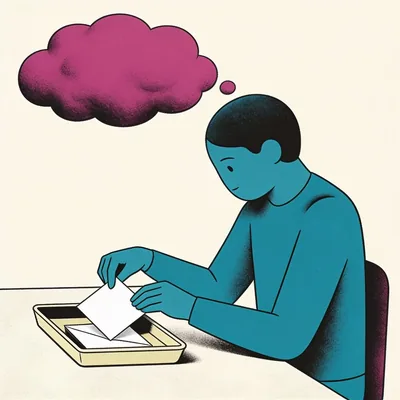
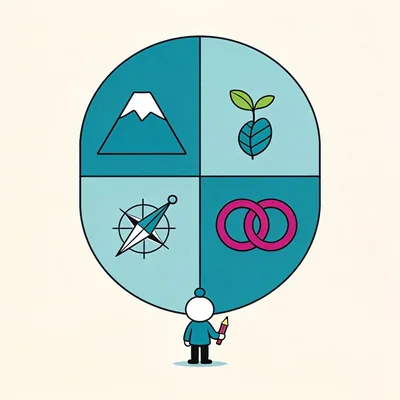
Petrol blue and raspberry on warm off-white, one per icebreaker, drawn in a single family so a deck of them still looks like one thing. No words in the artwork, so a Dutch invitation works as well as an English one.







Two complete icebreakers, free.
The same files that are in the library, not previews. Run one on Monday.
Emoji Check-In
The fastest honest read of a room there is — three minutes, works in person and in Teams, and doesn’t oblige anyone to explain themselves.
Human Bingo
The classic, written up properly: a card that gets a new team talking without turning into an hour of small talk, with the questions that quietly exclude people taken out.
Both are pay-what-you-want. €0 gets you the identical file.
Before you buy.
Why not sell the six themes separately?
Because at 45 items for €24, splitting it would cost you more than it saves. The retrospective library has category packs because its formats are bigger and you might genuinely only want one shelf; here you’d be paying twice for half a library.
Isn’t an icebreaker just a question?
Some of them are, and those are the one-page cards. The reason to buy a set rather than search for one is everything around the question: the group size it holds up at, the honest timing, whether it works on a call, what it asks people to reveal, and the two or three ways it reliably goes wrong.
Do these work remotely?
Every guide states its setting, and seven are built specifically for remote, hybrid and large groups. Where something only half works on a call, the guide says so rather than pretending.
Is it in Dutch?
The guides are in English. The illustrations carry no text, so running an English guide with a Dutch-speaking team is seamless — which is what most teams here do anyway.
Can I use them with clients?
Yes — facilitate them as often as you like, with any team, at any employer or client. You may not resell, redistribute or republish the files themselves.
What about the seasonal ones?
Twenty-nine seasonal icebreakers were deliberately kept out of this set. They may return later as a separate seasonal release.
Stop opening meetings with “so…”.
All products · The Retrospective Format Library · The bundle
How this was made. Selected, specified and reviewed by Sven Vogelezang, a working Product Owner and Scrum Master. The text and the illustrations were produced with AI tools under his direction: he set the structure, the metadata system and the quality bar, decided what went in and what stayed out, and reviewed the result. Nothing here is bulk-generated — every page was written against a house style, and a full review before release corrected three dozen problems, from impossible timings to activities that quietly exclude people.