
Why it works. And how to do it.
Two lines of guides for the people around agile teams. The Agile Explainer Series explains why something works, from real practice. The Deep Dives hand the team the tools. Every guide comes as a print-ready PDF, an EPUB and a presentation you can restyle in your own house style.
- PDF in A4 and US Letter
- EPUB for e-readers
- PowerPoint, restyled in one click
- Poster in A3, A4 and US Letter
Seven guides, written from practice.
Every guide grew out of in-depth interviews with a working Product Owner about teams inside a large organisation. The stories are real; names, numbers and the sector are left out, the mechanisms are not. Each chapter ends with two checklists: one for Scrum Masters and Product Owners, one for managers. The presentation in each package is written for management.
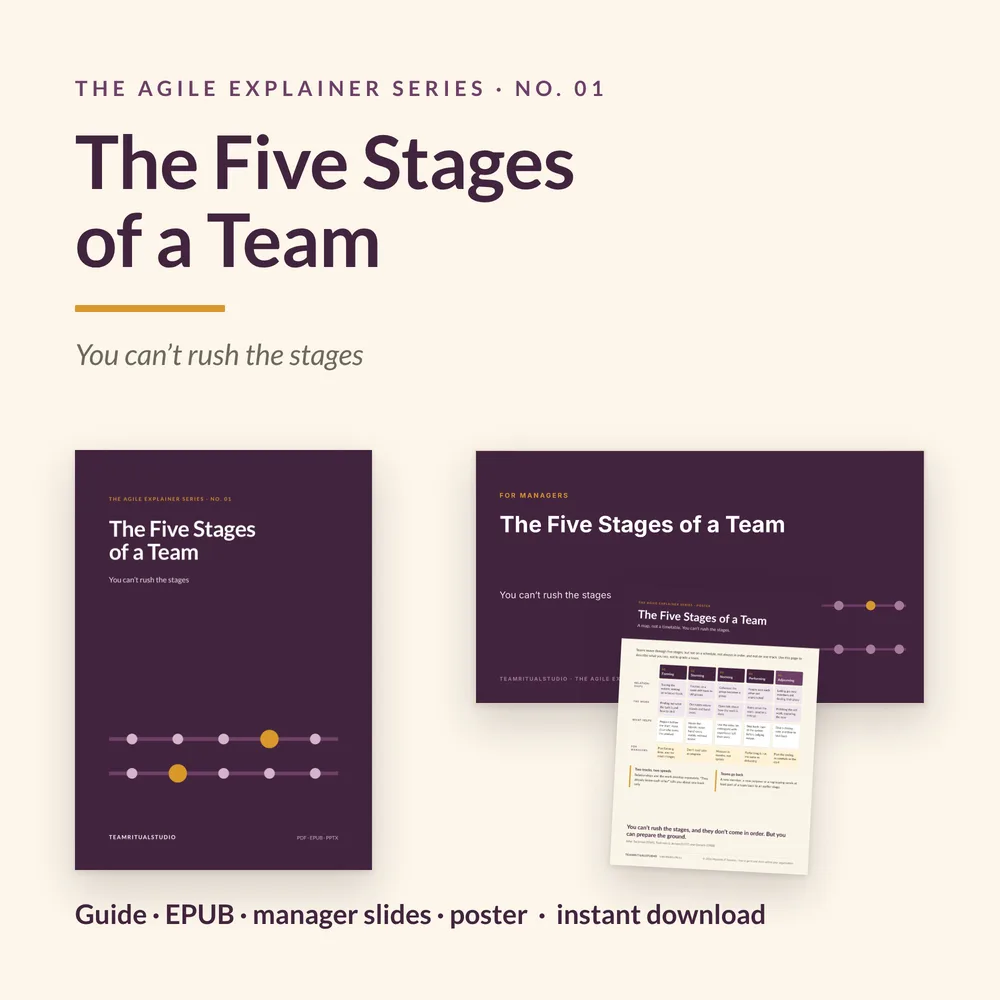
The Five Stages of a Team
You can’t rush the stages
Forming, storming, norming, performing and adjourning, as they look in teams that are formed, regrouped and restarted. 33 pages, slides, poster.
€9
Excl. VAT — added at checkout.
Also in our Etsy shop.
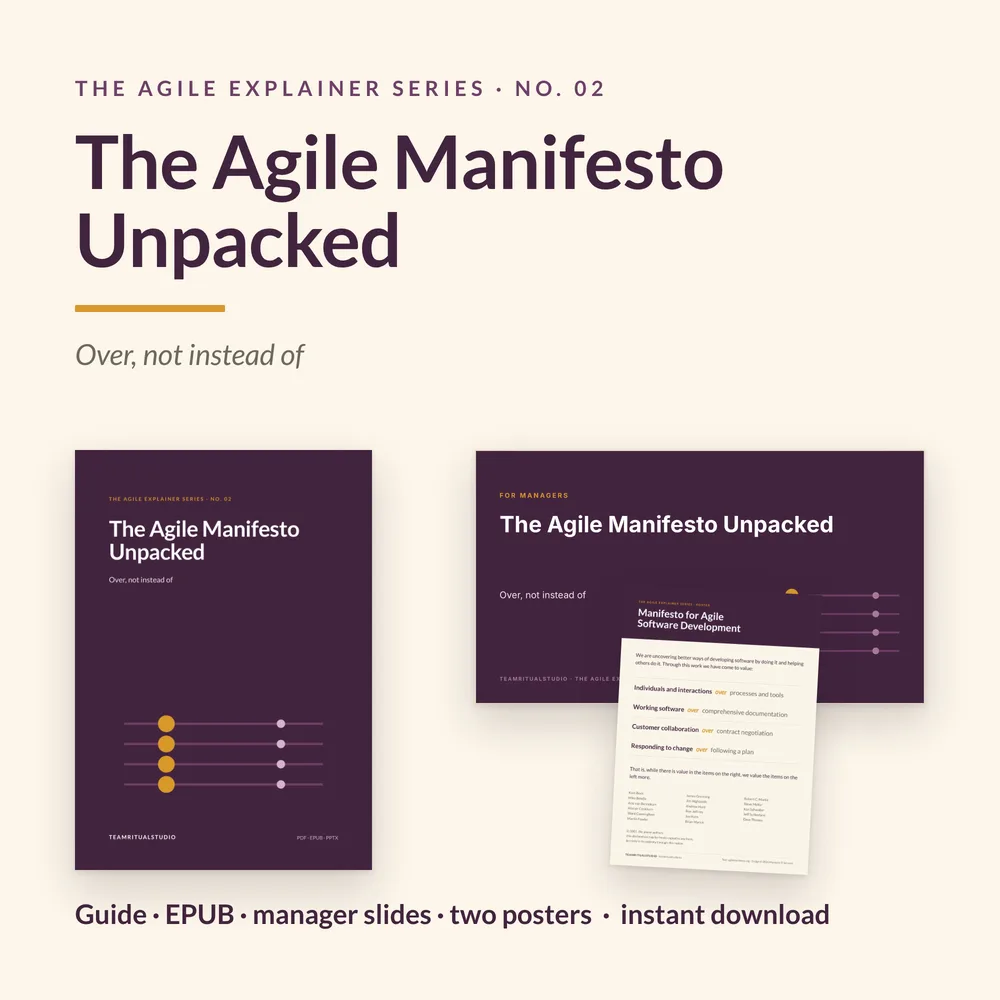
The Agile Manifesto Unpacked
Over, not instead of
What each value of the Manifesto asks of the people who fund, steer and judge the work. 43 pages, slides, two posters.
€9
Excl. VAT — added at checkout.
Also in our Etsy shop.
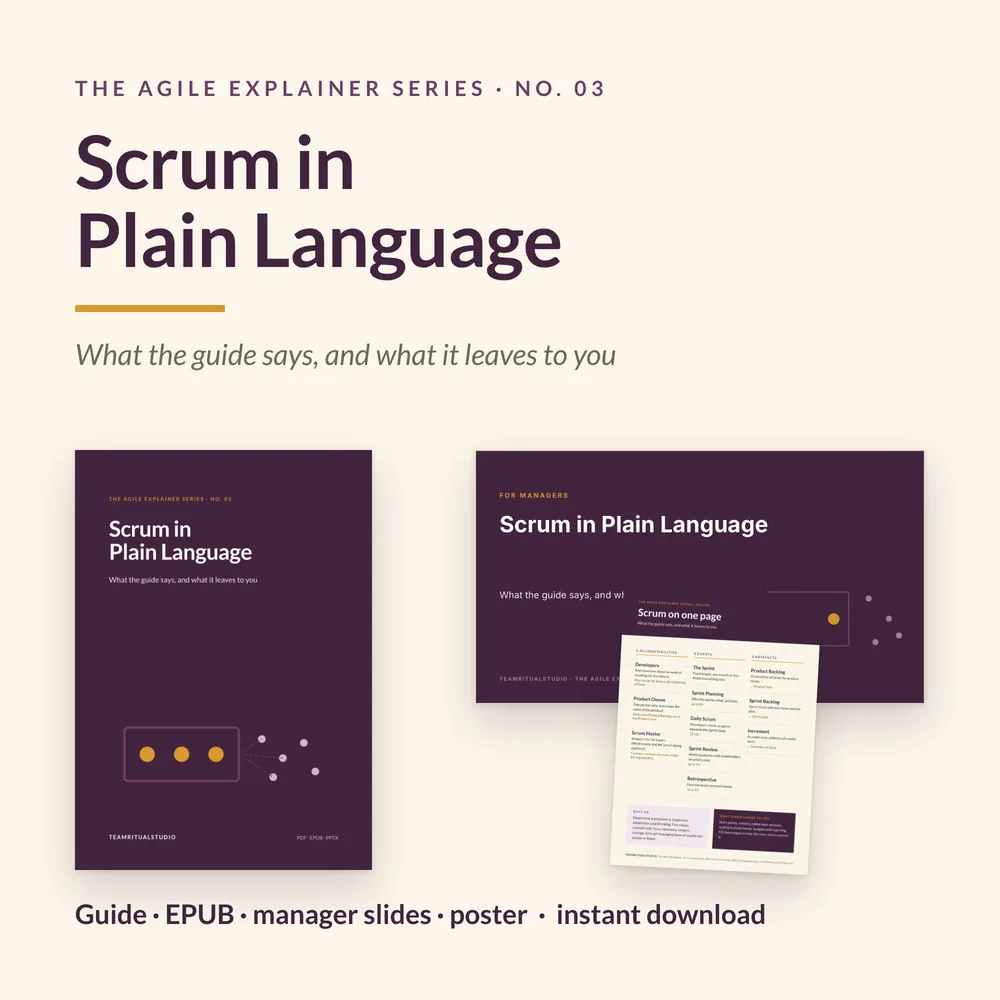
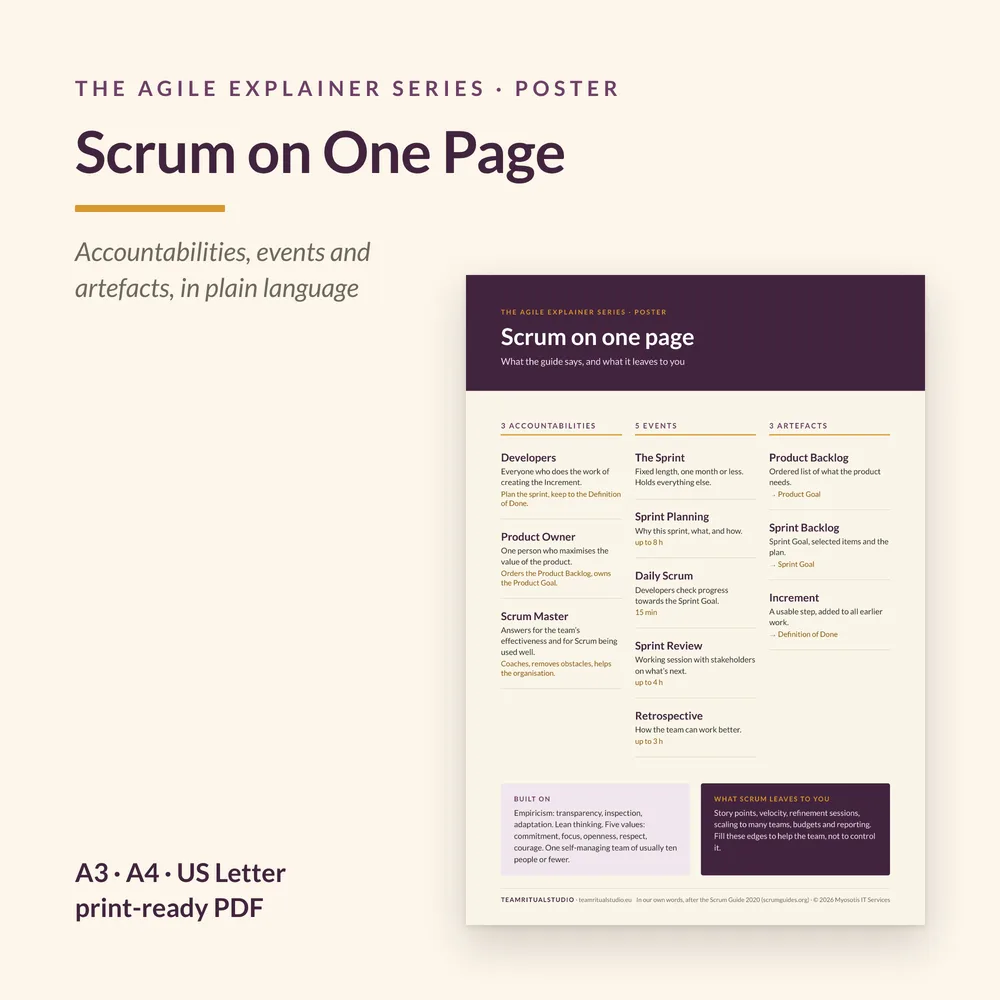
Scrum in Plain Language
What the guide says, and what it leaves to you
The framework in plain language, then the edges Scrum leaves open, where it goes right or wrong. 38 pages, slides, poster.
€9
Excl. VAT — added at checkout.
Also in our Etsy shop.
- No. 04 · Small Steps, Fast Feedback — Value first, then small
- No. 05 · Flow Basics — Why work flows, and why it gets stuck
- No. 06 · Agile at Scale — What changes when one team becomes many
- No. 07 · Agile in a Matrix Organisation — Who steers the people, who steers the work
When all seven are out, they also come together as one bundle.
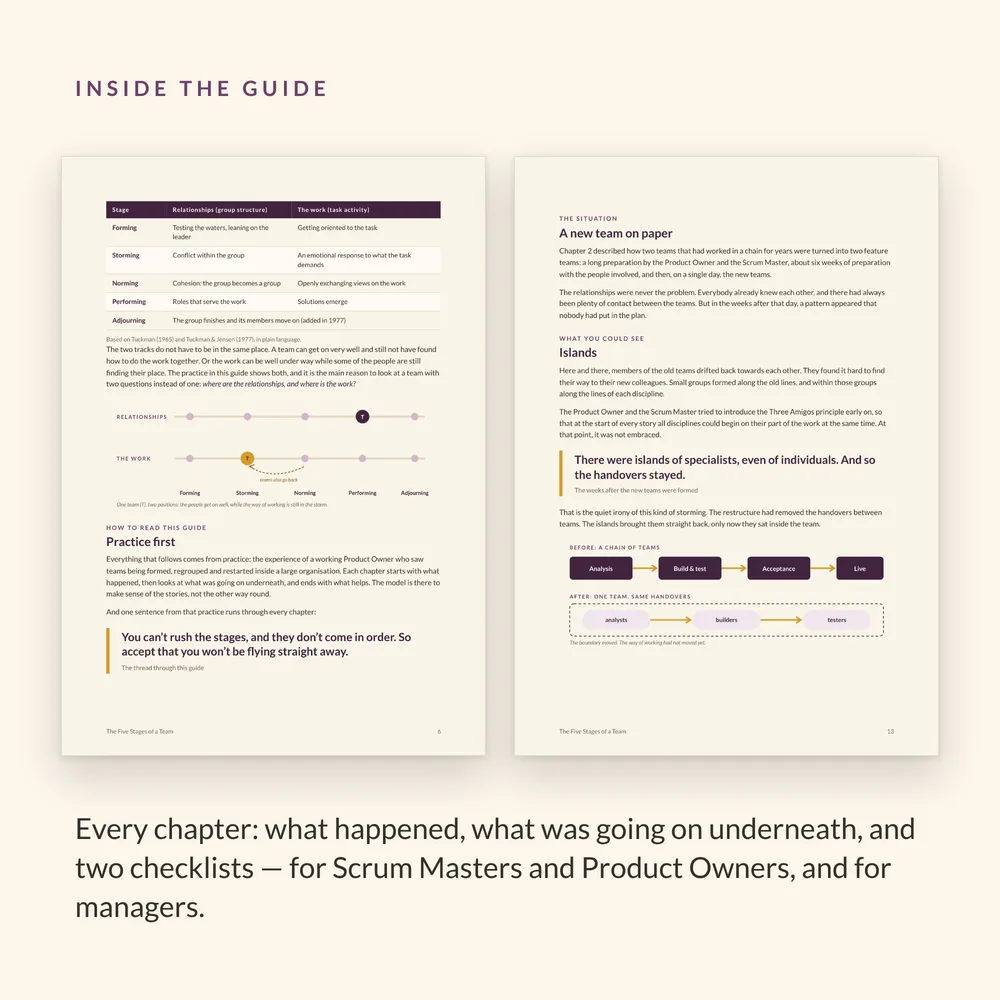
What happened, what was underneath, what helps.
Each chapter starts with a situation from practice, looks at what was going on underneath, and ends with what you can do on Monday. Around four pages per chapter, readable in one sitting.
The guides are written for managers and the business side as much as for teams: the people who fund the work, compose the teams and judge what they deliver. That is where most of what decides how agile working goes is decided.
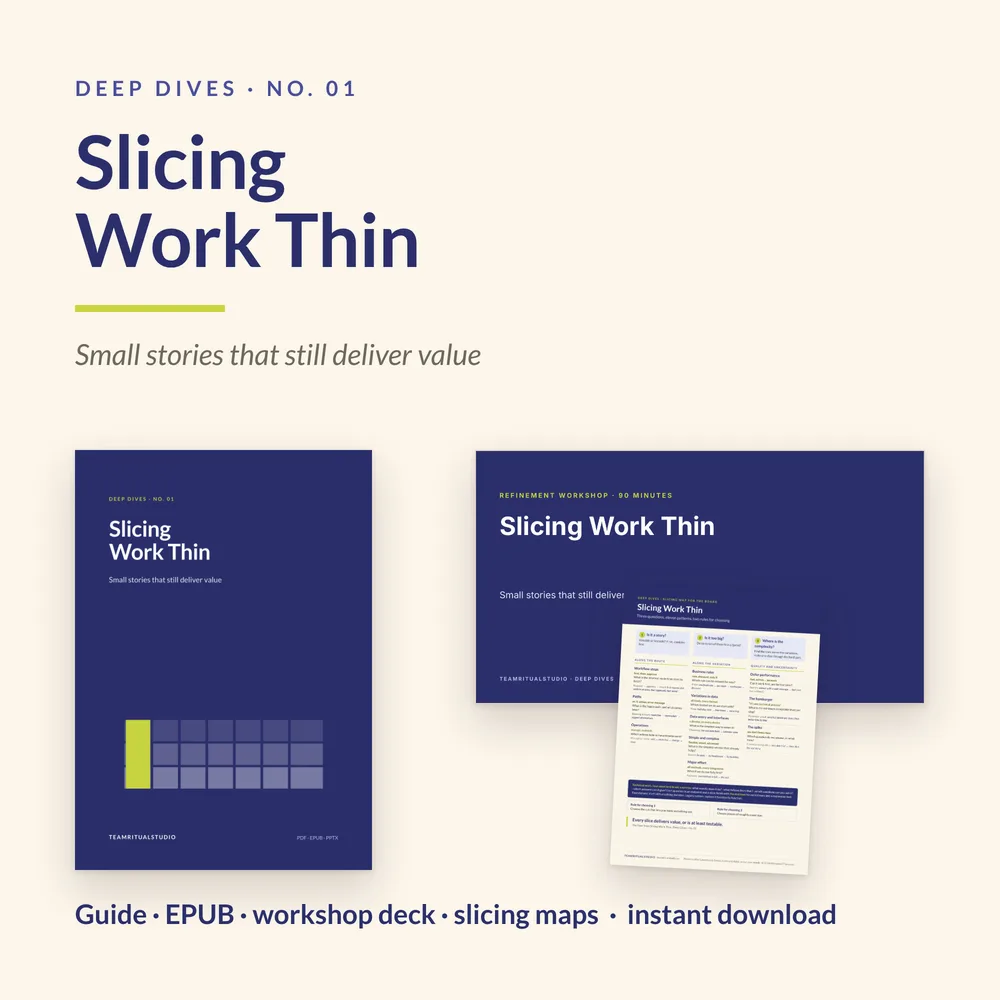
Slicing Work Thin.
Small stories that still deliver value. Splitting a big story is not hard; splitting it so that every piece still delivers something is the craft.
65 pages for the team and the Product Owner: a fixed approach in three questions, every slicing pattern applied to two worked examples from software development, the story map and the walking skeleton, and Elephant Carpaccio to practise. With a 16-slide workshop deck for a ninety-minute refinement session and the slicing map for next to the board.
The techniques come from the literature, all sources named; the stories from practice come from the same interviews as the series.
€12
One page, on the wall.
Every poster is included in its guide package. These three are also sold on their own; three more are free.
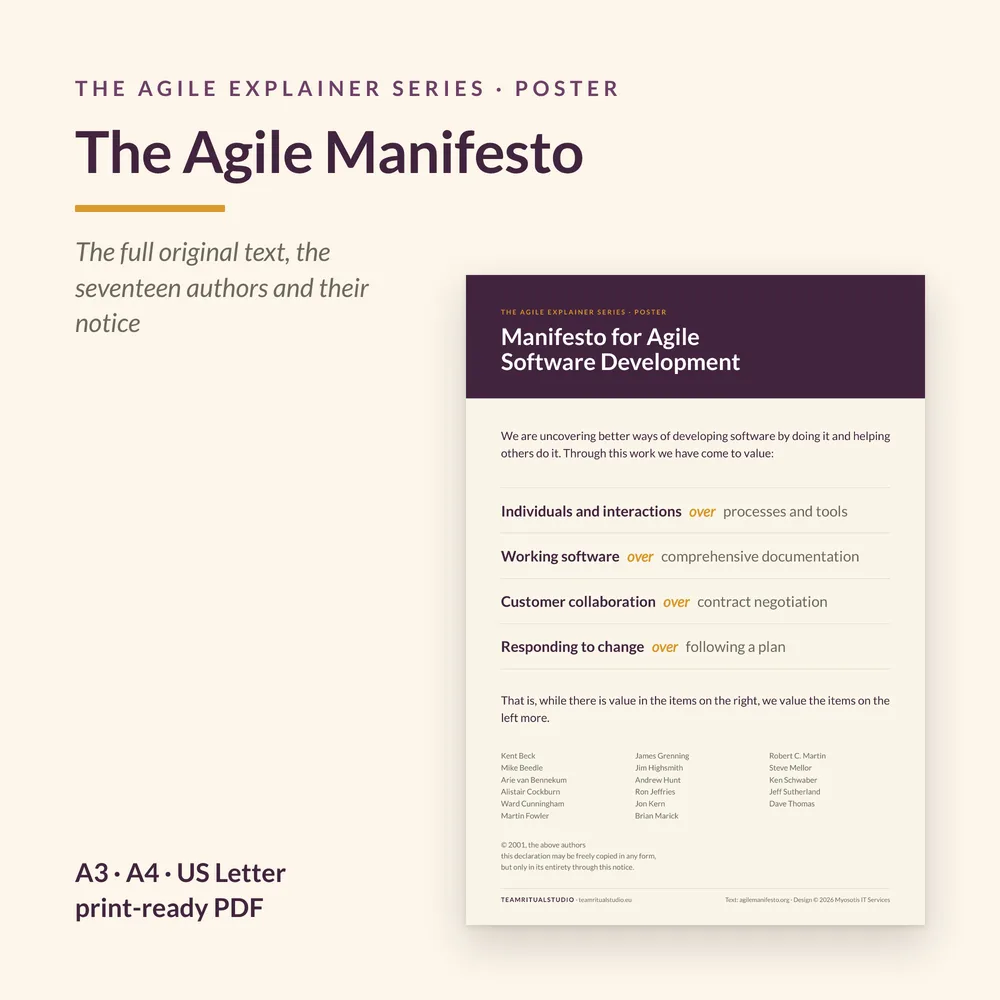
The Agile Manifesto
The full original text, the seventeen authors and their notice.
€4
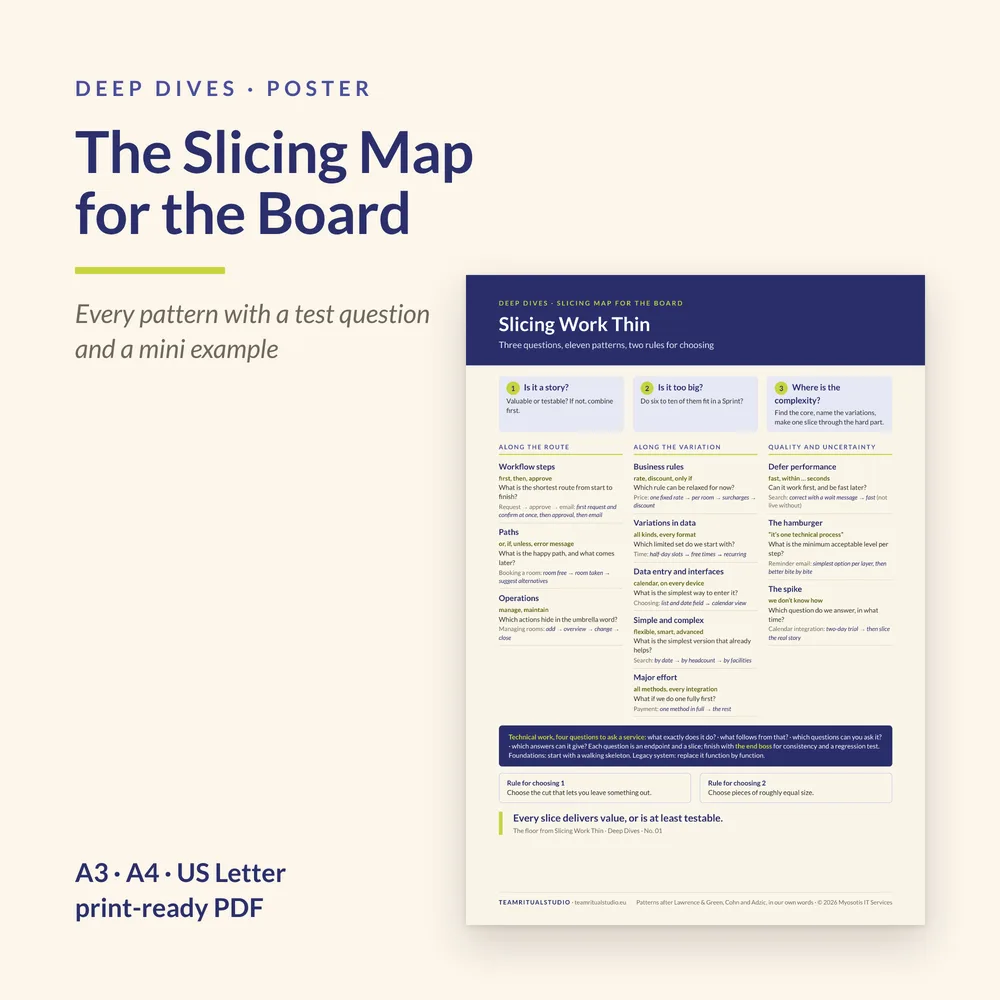
The Slicing Map for the Board
Every slicing pattern with a test question and a mini example.
€4
How this was made. The Agile Explainer Series grew out of in-depth interviews with Sven Vogelezang, a working Product Owner with 29 years in IT, who works side by side with Scrum Masters and steps into that role himself when the team needs it. The experiences, the stories and the views in it are his. AI tools were used to turn those interviews into text and illustrations, under his direction: he set the structure and the quality bar, decided what went in and what stayed out, and reviewed the result. For the Deep Dives, the same tools were also used to research the literature.